

It is widely acknowledged that when reading the Qur’ān one frequently encounters verses or passages that are restated or paraphrased in different places throughout the text, leading to varying levels of differences among these intratextual ‘variants’. A verse or passage might exist in a certain place in the Qur’ān and also be repeated elsewhere therein; a given variant may be either identical to its counterpart(s), or even apparently contradictory thereto. When it comes to the historical impetus underlying these variants, however, scholars offer different explanations. Angelika Neuwirth, for example, would argue that these differences “reflect the shifting concerns of the emergent community and were introduced to meet changing circumstances during the lifetime of Muhammad,” a position of which Stephen Shoemaker has been extensively critical.[1]
According to Shoemaker, many of the Qur’ān’s intratextual variants arise not from deliberate compositional adjustments during Muhammad’s lifetime but from the inherent fluidity of oral tradition and human memory. Drawing on memory science and anthropological studies of oral cultures, Shoemaker argues that qur’ānic traditions continually transformed as they were recalled, performed, and transmitted, with essentially each retelling introducing alterations, expansions, or recombinations. These processes, he tells us, generated alternate versions of the ‘same’ material that circulated independently before being committed to writing in different collections. Only later, he argues, when such oral variants were gathered and preserved side by side, did they become fixed as the parallel passages now found within the canonical text.[2]
Shoemaker’s Commentary on Q 55:46-76
According to Shoemaker, one example of this phenomenon of textual variance – rather than spanning multiple surahs – can actually be found squarely within Q 55; the latter, according to Shoemaker, containing two disparate descriptions of Paradise. The following table mimics the format of that which Shoemaker uses to analyze these two allegedly alternate portrayals[3]:
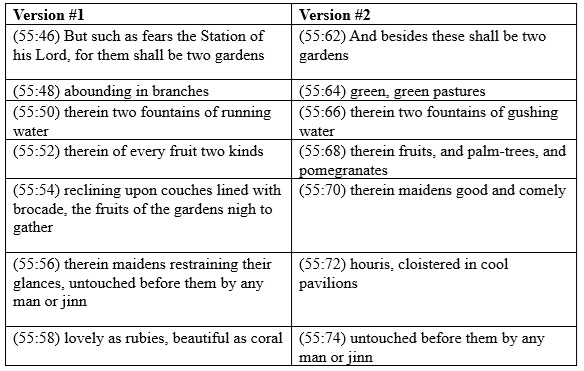
Concerning the above passages, Shoemaker offers the following remarks: “A prime example of a variant produced in the oral tradition occurs in Qur’an 55:46–76, where two versions of the same tradition are juxtaposed one after the other.”[4]
Shoemaker continues:
Clearly, we have here alternate versions of a single tradition that were produced in the process of oral tradition and then were recorded in writing independently—originally in separate collections one imagines, before being joined together one after the other, following very conservative editorial principles.[5]
Thus, at least prima facie, Shoemaker’s observations seem considerably straightforward: “these are two variants of the same tradition whose differences are the result of recurrent oral reproduction.”[6] As Shoemaker notes, his perspective on this matter has been significantly informed by the work of John Wansbrough (d. 2002),[7] the latter himself similarly of the view that “various passages of the Qur’an that relate the same information in very similar, but not quite identical, words and phrases reflect a single text that has evolved over a significant period of time.”[8] Without here fully adjudicating the broader role that editorial processes, memory, and oral transmission may have played in reshaping Muhammad’s revelations, we should at least ask whether Q 55 itself ‘clearly’ exhibits evidence of such processes – or whether its apparently discrepant portrayals of Paradise point to something else entirely.
A Closer Look at Q 55
In the view of the present author, before such wide-ranging conclusions as those of Wansbrough and Shoemaker can be confidently established, one must first undertake a number of preliminary examinations of the surah in question. Most importantly, it seems we should at least acknowledge the theoretical possibility that the similarities between Q 55’s two descriptions of Paradise might be the result a linear process of composition rather than that of a combining of two or more originally independent ones. In fact, following a careful investigation of the surah in question, a linear process of this sort appears to have been precisely the case. In order to see why, however, one must consider how these paradisiac portrayals relate to Q 55 as a whole – a consideration conspicuously absent from the treatments of both Wansbrough and Shoemaker.
Examining the entirety of this surah, we see that its implied audience comprises not one but two species of potential believers: humans and jinn. That two distinct entities are being addressed is perhaps best illustrated by the refrain that appears after every other verse in Q 55:46-76 reads as follows: fa bi-ayyi ’ālā’i rabbikumā tukhadhdhibān (“So which of the signs of the Lord of you both will the two of you deny?”). Opening with the most common epithet of the qurʾānic deity (al-Raḥmān; see v. 1), Q 55 is primarily aimed at delivering a single theological message – namely, that of divine mercy. Accordingly, what the surah conveys is that members of each of these two groups (man and jinn) are offered the possibility of the reward of Paradise if they choose to serve and obey God – each paradisiac reward here being inclusive of two gardens. Thus, with respect to the paradisiac rewards of 55:46–61 and 55:62–76, we contend that the former textual block describes the two gardens God promises to man and the latter the two promised to the jinn. In order to establish this contention, a brief walk-through of Sūrat al-Raḥmān (Q 55) is in order.
As stated above, Q 55 opens by invoking al-Raḥmān (v. 1). From here it immediately situates the surah under the twin themes of divine mercy and power. Verses 2-12 present God’s creative acts (teaching the Qurʾān, creating humankind, establishing cosmic order and justice), while vv. 8-9 explicitly call God’s servants to act justly. The dual address that dominates the rest of the surah is introduced at v. 13 (fa bi-ayyi ’ālā’I rabbikumā tukhadhdhibān) and is immediately clarified in vv. 14-15, which name the two audiences: humanity and the jinn. Thereafter the theme of duality and the motif of dual address recur in the form of a refrain, doing so within the context of the surah cataloging, among other things, God’s sovereignty over creation (vv. 17-25), His eternity in contrast to the mortality of all creatures (vv. 26-30), and the hellish punishment that awaits the unrighteous among both groups (vv. 31-45). Only after this shared warning does the surah turn to reward. Verses 46-61 describe one set of paradisiac gardens; vv. 62-76 describe a second, parallel set. In our view, this twofold structure of the entire surah strongly suggests that these two portrayals of Paradise are not variants of a single tradition, but differentiated rewards allocated respectively to righteous humans and righteous jinn.
It is not necessary to demonstrate that the first set of rewards in question (vv. 46-61) applies to humanity: scholarship already treats humans as the default beneficiaries of divine recompense. Establishing that vv. 62-76 apply specifically to the jinn, however, requires further observation. Nevertheless, this possibility is seemingly made clear by the fact that the contents of this second reward appear tailored to the jinn race in particular. This point is most evident in the usage of the hapax legomenon ʿabqarī found in v. 76 (rendered “druggets” or “carpets” in the table above). While in context the term denotes something upon which one reclines, its morphology is revealing: the long final vowel is the yāʾ of nisbah, indicating relation to a place-name – in this case ‘Abqar. In the milieu of the Qurʾān, ‘Abqar was understood as the principal abode or “capital” of the jinn.[9] Admittedly, ʿabqarī can also carry non-literal connotations, denoting exotic or precious items that had reached the Arabs from distant lands such as Rome or Persia.[10] In the present context, however – where the dual address and explicit mention of the jinn already establish the latter as part of the surah’s implied audience – the interpretation linking ʿabqarī to the jinn’s traditional abode, it seems, should be given exegetical priority. The employment of ʿabqarī here thus aligns the second paradisiac portrayal of Q 55 (vv. 62-76) with the jinn specifically. Accordingly, the two pairs of gardens of which we read in Q 55 appear not to be two portrayals of the same Paradise, but two separate portrayals of two distinct facets of Paradise.
In light of the above observations, a final criticism of the positions of Wansbrough and Shoemaker may be advanced. As the above table illustrates, both descriptions of Paradise mention women untouched by man and jinn (vv. 56, 74). The man–jinn juxtaposition that permeates throughout virtually this entire surah is thus present within each of the paradisiac portrayals themselves. Moreover, a fairly consistent rhyme pattern – long ā followed by a consonantal coda (e.g., qurʾān, insān, tukadhdhibān) – runs throughout Q 55 (with only minor exceptions at vv. 17 and 29) and is maintained in both paradise sections. These features give the strong impression that these paradisiac portrayals are original to Q 55: one may therefore reasonably insist that Wansbrough and Shoemaker bear the burden of identifying textual clues that point to the contrary. For his part, Shoemaker attempts to justify his position by appealing to hypothetical processes of textual alteration through which the two descriptions were combined “following very conservative editorial principles.”[11] While such a scenario cannot be ruled out in principle, and future discoveries might yet lend it support,[12] the weight of the internal evidence currently points in the opposite direction. Shoemaker’s thesis here, therefore, makes sense in theory; yet he offers very little supporting evidence in this regard. Pace Shoemaker, merely affirming the possibility of an alternative developmental path, without demonstrating why that path should be preferred to a unitary reading of the surah, is ultimately to say very little.
Conclusion
The foregoing analysis has sought to show that the two descriptions of Paradise in Q 55 form part of a single, coherent discourse addressed to both humans and jinn. The consistent man–jinn juxtaposition, the sustained rhyme pattern, and the parallel structure of the two garden-related pericopes (vv. 46-61 & 62-76) all point in this direction and weigh against the alternative scenario(s) advanced by Wansbrough and Shoemaker. In conclusion, we may ask how, exactly, the present study stands in light of traditional Islamic scholarship surrounding the surah under discussion.
Classical exegetes, beginning with figures such as Ibn Zayd (d. 798) and Abū Mūsā al-Ashʿarī (d. 665), according to al-Ṭabarī (d. 923), generally preferred a hierarchical reading of Q 55’s portrayals of Paradise: the gardens of vv. 46-61 for the foremost of the believers (al-sābiqūn) and those of vv. 62-76 for the Companions of the Right (aṣḥāb ’l-yamīn), the latter constituting a hierarchically inferior class of believers.[13] Later authorities, including Ibn Kathīr (d. 1373),[14] al-Zamakhsharī (d. 1143),[15] and Ibn al-Qayyim (d. 1350),[16] largely maintained this qualitative distinction while citing Q 55 as evidence that both humans and jinn may enter Paradise.
The present study proposes a different approach. Rather than ranking the two portrayals, one may regard them as commensurate rewards offered within a unified address to the two subgroups within its audience. Of course, it does seem to be the case that the gardens of vv. 46-61 are described in more detail than those of vv. 62-76: traditional commentators seem to have inferred from this verbosity an element of qualitative superiority. Interestingly enough, it seems that such an inference would actually further contradict the idea that these two sets of rewards reflect variants of a common tradition.[17] And it is possible for one to agree that the first of these (vv. 46-61) is for humans and the second (vv. 62-76) for jinn while simultaneously affirming the former’s qualitative superiority over the latter: such a reading would of course imply that, for some reason, the paradisiac gardens promised to humans are superior to those promised to the jinn. Nevertheless, despite the fact that its adoption might serve as subsidiary evidence in favor of the present study’s overarching thesis, the present author hesitates to endorse this view, at least for the time being. Accordingly, the question of whether the difference between these two sets of gardens is actually qualitative must at present be ultimately left to the reader to decide.
[1] Stephen J. Shoemaker, Creating the Qur’an: A Historical-Critical Study, p. 217.
[2] Ibid., esp. chs. 5-7.
[3] See Table 5 in Ibid., p. 218. It is important to point out that Shoemaker has here excluded certain verses. Consequently, fifteen verses are missing from his (and our) table (vv. 47, 49, 51, 53, 55, 57, 59, 61, 63, 65, 67, 69, 71, 73, 75). Each of these are actually identical to one another, hence these fifteen excluded verses are simply fifteen repetitions of a single phrase.
[4] Ibid., p. 218.
[5] Ibid., pp. 218-219.
[6] Ibid., p. 218.
[7] For Wansbrough’s thoughts on the passage in question, see John Wansbrough, Quranic Studies: Sources and Methods of Scriptural Interpretation, pp. 25-27.
[8] Fred Donner, “The Qur’ān in Recent Scholarship,” p. 34.
[9] Nazeer El-Azma, “The Qurʾān and Poetry,” p. 75; Irfan Shahīd, “The ‘Sūra’ of the Poets, Qurʾān XXVI: Final Conclusions,” pp. 181-182.
[10] Yasir Qadhi, “Brief Thematic Tafsir of Surat Ar-Rahman – Dr. Yasir Qadhi | 25th July 2014,” Yasir Qadhi, https://youtu.be/L7IVWnKRRRk.
[11] Stephen J. Shoemaker, Creating the Qur’an: A Historical-Critical Study, pp. 218-219.
[12] In fact, Julien Decharneux has argued that a separate portion of Q 55 may reflect the work of a secondary editor. While the present author disagrees with Decharneux in this respect, an engagement with his thesis is beyond the scope of the present work. Suffice it to say that, even if one is convinced by Decharneux’s thesis, the implications of the latter in no way undermine the findings of the present essay. See Julien Decharneux, Creation and Contemplation: The Cosmology of the Qur’ān and Its Late Antique Background, 205-210.
[13] https://tafsir.app/tabari/55/46.
[14] https://tafsir.app/ibn-katheer/55/46.
[15] https://tafsir.app/kashaf/55/46.
[16] https://tafsir.app/ibn-alqayyim/55/46.
[17] I am grateful to Bilal Muhammad for bringing this point to my attention.
